Showing posts with label Crystal. Show all posts

Friday, January 30, 2015

Crystal Clear - Process

Crystal clear process includes three steps

1.Chartering, 
2.Cyclic Delivery 
3.Wrap-up


Chartering: 

Chartering includes building the core team, performing the exploratory 360°, shaping & fine-tuning the methodology conventions and building the initial project plan.
            
            Build the core of the team:
Is nothing but forming the development team
An Executive Sponsor provides direction and support to the team, also act as domain expert for the project.
A Lead Designer acts as project manager, coordinator, technical expert and trainer.
An Ambassador User acts as the expert on system usage.
A number of Systems Analysts, Programmers, Support analysts, Business Experts, Testers, Text-Writers, Coordinators and others (Whoever is needed by the team).

            Perform the Exploratory 360°:
It is preliminary feasibility analysis which provides high level project review of the key issues (given below) which will affect the development effort
Overall project plans and constraints
High-level requirements (usually captured in use cases)
Expected business value
Technology to be used & alternatives
Necessary resources
Development methodology

            Shape and fine-tune the methodology conventions:
Shaping the methodology: Set of rules which are agreed upon by the team as the framework to be used in developing the system
Fine tuning methodology: Initial framework will be reviewed & revised iteratively during cyclic delivery, gradually evolving as a methodology tailored to fit the project.

            Build the initial project plan:
Developing the initial plan which includes project map (Consists tasks and their dependencies), Release plan with projected timelines (start and end date) for delivery cycles & iterations and Tasks (Prioritized and estimated).
Task estimations are done using Blitz Planning, which is a close variant of XP’s card-based planning technique.


Cyclic Delivery:

Each delivery cycle includes either one iteration or multiple iterations which leads to delivery to the real users. Each delivery cycle includes below activities to be performed
     Recalibrate\Revisit the release plan
     Develop in iterations
     Deliver to real users
     Reflect on the delivery
Recalibrate\Revisit the release plan: Release plan is reviewed and updated based on the experience with previous delivery cycles performance.
Develop in iterations: All the development is done in iterations which can range from one week to three months. One delivery cycle can have one or multiple iterations.
Deliver to real users: Integrated system is delivered to a group of users and use their feedback is used to improve the system. Update the plans/requirements according to the user feedback.
Reflect on the delivery: Reflection workshop is held and the team reflects on the delivered product and process used to develop the product.

Cyclic Delivery - Iteration:
Iteraration starts with Iteration planning, where team plans the tasks to be performed during the iteration.  Each iteration include multiple days integrated.

Each day (Cyclic program-test-integrate) includes
A Daily Standup meeting: Team meets to collaborate with one another
Mutiple Integration Cycles: It consists of Designer-Programmers developing tasks by programming and perform unit testing. These are called episodes. At the end of the integration cycle new code should be integrated into the system and integration tests should be performed.
Iteration Completion Ritual: A reflection workshop is held at the end of the iteration.


Crystal Clear Process-Wrap-up:

Wrap-up is the last step, in which Team performs acceptance testing and prepares the final product & user environment for final deployment.
Final reflection workshop.
Create Knowledge base: Record the lessons learned from the project which will be helpful for future projects.

Hope you got some idea on the crystal clear process. In next  post, let’s get started with eXtreme Programming. Please share your feedback to improve this blog or let me know if you need any specific topics to be covered. I will be very happy to present it in my blog.If you have any suggestions OR queries, Please feel free to reach out to me @ Linkedin || Facebook

Very Happy to see 1000 page views to my Blog, Thank you J

Twitter: @sathrambalaji

Have a nice day
-Balaji Sathram, CSP, PMI-ACP

Wednesday, October 29, 2014

Crystal Methodologies - Common properties

Hope you got to know: what is crystal family of methodologies from previous post. In this post, let’s discuss about Crystal Methodologies – Commonality .i.e.nothing but properties common among all crystal family members.

These are the common properties (given below) among different methods of crystal famiy.
1.  Frequent delivery
2.  Reflective improvement
3.  Osmotic communication
4.  Personal safety
5.  Focus
6.  Easy access to expert users
7. Technical environment (With Automation testing, configuration management and frequent integration)

Out of the above, first three properties are core properties of crystal and rest are the properties which increases project safety by dealing with adverse conditions. Let’s discuss one by one in more detail.

Crystal Family members - Common Properties

Frequent delivery: 
Deliver usable software atleast once a quarter (Delivery cycle can vary from a week to a Quarter).
Crystal suggests to deliver usable software atleast once a quarter. Delivered software must be running, tested with usable functions. Delivery cycle shouldn’t be more than four months, so that problems/issues can be found and fixed early. Customers/Stakeholders can provide feedback on the working software which helps team to tailor things with respect to people/process/product.

Reflective improvement: Inspect and Improve
All team members get together atleast once in a quarter to discuss about ‘what is working good’, ‘what is not working good’ (Factors slowing down team’s work) and ‘is there any improvements/modifications to be done?’. This is called reflection workshop. Short iterations help teams to evaluate the process they are following.

Osmotic communication:
All team members working for a project to be seated in same room/same building (Co-location), which helps in effective communication and quick information flow through the team. The main objective behind all team members getting seated in the same room is that: team members can overhear the discussions happening in background (though they are not directly involved in) and pick up relevant information. Through this, Communication overhead is reduced and  it takes less time to get the answers for your questions.

Personal safety:
Team members must be able to speak to team without any hesitation/inhibitions. Members should be able to discuss with the team about anything. For example: wrong estimations, friendly disagreements etc. Main objective behind this property is creating an environment where team members can share their views without thinking about what others think about their views.

Focus:
Goals of the project is well defined and all team members should know their top two priority items/tasks to work on. Members should get at least two days in a row with two hours each day to work with out any interruptions. This will increase focus on a item/task long enough for progress towards project goal.

Easy access to expert users:
Team members should work with experts to get their questions answered. Experts/End-users would suggest improvements or solutions. Experts should be available to team (either by person or reachable by phone), so that team get answers to their questions in few hours.

Technical environment (With Automation testing, configuration management and frequent integration):
Developers need to check their code into configuration management system and run automated system tests to identify errors/problems with the changes being made. It should be done regularly to identify erros/problems early and fix it.

In this post, We have discussed about common properties among all crystal family members. Will discuss about crystal-process in next post.

Thank you for visiting my blog and spending some time. It would be great, if you could share your feedback as it helps me to improve. If you have any suggestions OR queries, Please feel free to reach out to me @ Linkedin Facebook

Twitter: @sathrambalaji

-Balaji Sathram

Thursday, May 1, 2014

Crystal - It is about Self-awareness

Hi all, Thank you for coming back and reading my blog. I know that it’s been couple of months since my last post. My apologies for that. I was in to job trials, facing some health issues but finally could come out of it. Joined new organisation, completed all medical tests and………  back to blogging with more energy. Let’s get into our subject. In earlier post, we have discussed about kanban. Let’s discuss about Crystal methodology in this post.

Crystal is introduced by Alistair Cockburn as a family of methodologies in 1998. He says that, he developed crystal methodologies to get rid of software engineering which always questions as "Is our model accurate?". Think about "Is our product meeting the customer's needs?" and "Do we have our goals aligned as a team?", which gives you better product leading to customer satisfaction. Crystal Methods focuses on communication, with special focus on interaction, community, people and skills.

Picture: Alistair Cockburn
In Cockburn’s words, “Crystal is a family of human-powered, adaptive, ultra light and stretch-to-fit methodologies sharing a common genetic code.”

It is mainly developed based on two important things i.e. 
1) teams can streamline their process as they start working 
2) Each project is unique and dynamic which requires unique methods designed for it.

The Crystal Family:
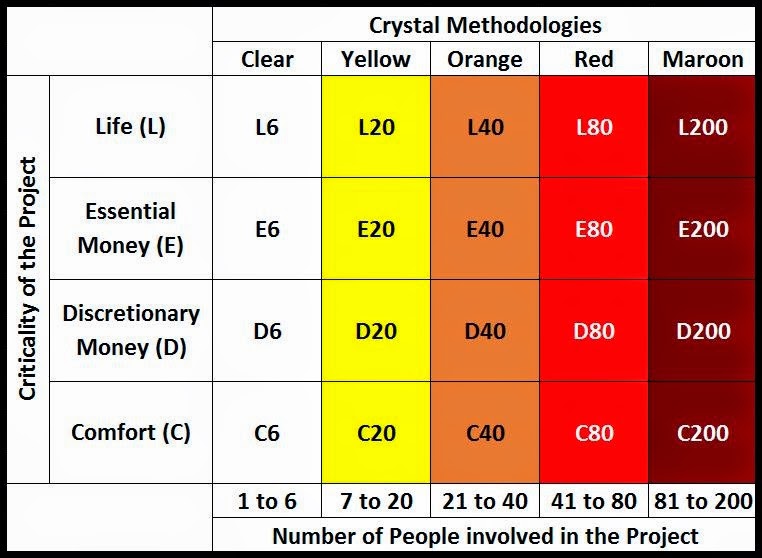
Though it has started in 1998, New members of the family were defined in 2001 and 2004. Based on the belief that each project is unique and it may require a slightly tailored set of policies, practices, and processes in order to meet the project’s unique characteristics. It requires unique methodology designed for it. Crystal methodologies are categorized according to the project size (number of people of involved in the project) that they address and the criticality of the project.

Let’s discuss these factors in detail below

1) Criticality: "Criticality" is defined by the sentence "A defect in the delivered product could cause loss of "

Comfort (C)
Discretionary Money (D)
Essential Money (E)
Life (L)

                                 For example:
Loss of comfort & Loss of Life are self-explanatory
Loss of Discretionary Money (e.g.System errors which have manual fix)
Loss of Essential Money (e.g.System errors which causes bankruptcy)

2) Project size: number of people working the project. For example, L40 project is a project which involves up to 40 people developing a life-critical system. Based on the people working/getting involved in the project decides it’s size.


Crystal methodologies: 
Based on the above listed factors crystal methodologies have been grouped in to different groups. It uses different colours to denote the “weight” of the methodology. Darker the colour, heavier the methodology. Crystal methodologies named in the literature are
Crystal Clear
Crystal Yellow
Crystal Orange
Crystal Orange Web
Crystal Red
Crystal Maroon
Crystal Blue
and Crystal Violet

Out of the above crystal methodologies, The methodologies which were practically used in real projects have been defined

Crystal Orange: Introduced in 1998, targeting C40, D40 and E40 projects.
Crystal Orange Web: Introduced in 2001, targeting web development projects.
                             Crystal ClearIntroduced in 2004, targeting C6 and D6 projects.

Picture: Crystal Methodologies-Aerial View
Crystal Methodologies - Commonality:
There are some common properties (given below) between different methods of crystal famiy.
1.    Frequent delivery
2.    Reflective improvement
3.    Close or osmotic communication
4.    Personal safety
5.    Focus
6.    Easy access to expert users
7.    Automation testing, configuration management and frequent integration

Let’s discuss about these commonalities and Crystal clear-process in next post. Would like to conclude this post with some short, meaningful sentences by Alistair Cockburn. He came up with these from his discussion with participants

Scrum is about self-organization
XP is about self-discipline
Crystal is about self-awareness

Your feedback is important to me; Help me to improve by giving your feedback. I appreciate it very much! Please feel free to reach out to me @ Linkedin Facebook

Twitter: @sathrambalaji

-Balaji Sathram